
Pallet Inverter

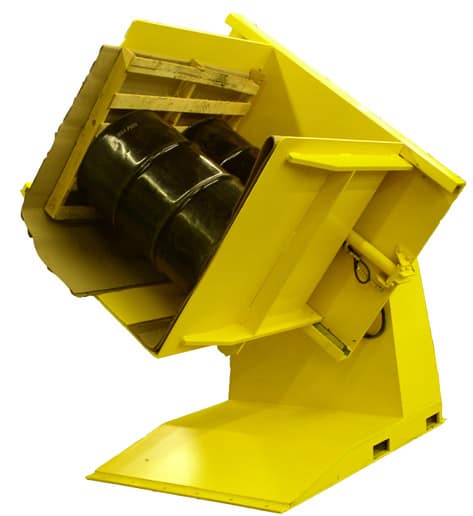
Product Features
Pallet Inverter Delivers Faster, Safer and More Efficient Load Handling
- 2,000 and 4,000 lb. load capacities with the ability to handle palletized loads up to 64 inches high and rotate them through 180°.
- A secure, uniform clamping system features parallel-moving clamping plates that travel along a rugged track to hold the load securely throughout the rotation process.
- Two-way fork pockets built into the self-supporting base make the pallet inverter easy to position, relocate, and integrate into different work areas.
- Simplifies damaged pallet replacement by allowing operators to remove a damaged pallet, box, or bag from beneath a fully loaded stack without manually unloading the entire load.
- Efficient load transfer allows complete loads to be transferred from one pallet or platform to another, reducing manual handling and minimizing downtime.
- Versatile material inversion can be used to rotate stacks of sheets, paperboard, rolls, and other materials, eliminating the need to handle individual items one at a time.
Improves workplace efficiency by reducing manual load handling, streamlining pallet exchange, and helping operators complete repetitive material handling tasks more efficiently.
Request Quote
Pallet Inverter for Safe and Efficient Load Transfer
When a damaged pallet needs to be replaced, a load must be transferred between pallet types, or a heavy stack needs to be inverted, manually handling the load can be time-consuming and create unnecessary safety risks. The Air Technical Industries (ATI) Pallet Inverter provides a controlled way to rotate and transfer palletized loads while reducing the need for manual handling.
Also commonly referred to as a pallet flipper, a pallet inverter machine secures and rotates an entire load so operators can access the pallet or reposition materials without dismantling the stack.
Designed for demanding warehouse, manufacturing, distribution, and material handling applications, the ATI Pallet Inverter rotates loads up to 180° and is available in 2,000 lb. and 4,000 lb. capacities. It can accommodate palletized loads up to 64 inches high, making it suitable for a wide range of products and materials.
The machine features parallel-moving clamping plates and a self-supporting base with two-way fork pockets for equipment positioning and relocation. These features make it a practical solution for facilities seeking to improve pallet exchange, load transfer, and material inversion operations.
What Is a Pallet Inverter?
A pallet inverter is an industrial material handling machine designed to securely grip and rotate palletized loads. Instead of manually unloading a pallet, operators can use the machine to rotate the complete load, providing access to the original pallet or allowing the load to be transferred to another platform.
This equipment is particularly useful when a pallet becomes damaged, contaminated, or unsuitable for the next stage of handling.
For example, a warehouse receiving products on wooden pallets may need to transfer those products onto different pallets before they enter a designated storage or production area. A pallet inverter can simplify the transfer process by reducing the need to unload and restack individual cartons or materials.
Pallet inverters are also used to invert certain stacks of sheets, paperboard, rolls, and other industrial materials.
The primary purpose of a pallet inverter is to rotate a secured load as a complete unit, reducing repetitive manual handling during pallet exchange and material repositioning.
Pallet Inverter Technical Specifications
Selecting the right pallet inverter begins with understanding the equipment’s load-handling capabilities and operating features.
| Specification | ATI Pallet Inverter |
|---|---|
| Equipment type | Industrial pallet inverter / pallet flipper |
| Available load capacities | 2,000 lb. and 4,000 lb. |
| Rotation capability | Up to 180° |
| Maximum stated load height | Up to 64 inches |
| Load securing mechanism | Parallel-moving clamping plates |
| Clamping plate movement | Uniform travel along a rugged track |
| Base design | Self-supporting base |
| Equipment positioning | Two-way fork pockets |
| Primary applications | Pallet exchange, load transfer, material inversion |
| Suitable environments | Warehousing, manufacturing, distribution, industrial material handling |
Choosing Between 2,000 lb. and 4,000 lb. Capacities
ATI offers two pallet inverter capacity options to accommodate different industrial material handling requirements.
The 2,000 lb. model may be suitable for applications where the complete load falls within the equipment’s rated capacity. Facilities handling heavier loads can evaluate the 4,000 lb. model.
However, load weight is not the only consideration. Buyers should also evaluate:
- Overall pallet and load dimensions
- Height of the stacked materials
- Load stability and packaging
- Weight distribution
- Pallet or platform configuration
- Frequency of pallet exchange
- Available operating space
A load within the machine’s rated weight capacity may still require additional evaluation if it has an unusual shape, unstable packaging, or dimensions outside the supported configuration.
Contact ATI with your load specifications to determine which pallet inverter model best suits your operation.
How Does the ATI Pallet Inverter Work?
The ATI Pallet Inverter uses a controlled clamping and rotation process to secure and invert palletized materials.
Its parallel-moving clamping plates travel uniformly along a rugged track, helping maintain contact with the load during rotation.
The general pallet inversion process involves the following stages.
Step 1: Position the Palletized Load
The palletized materials are positioned within the inverter according to the machine’s operating instructions.
Before operation, the load should be evaluated for weight, dimensions, stability, and suitability for inversion.
Step 2: Secure the Load with Clamping Plates
The machine’s clamping plates move into position to secure the palletized materials.
Proper clamping is essential because the load must remain stable as its orientation changes.
The clamping arrangement helps reduce unnecessary movement of the secured stack during inversion.
Step 3: Rotate the Secured Load
Once the load has been secured and the operating area is clear, the inverter can rotate it through 180°.
This changes the orientation of the palletized stack, allowing access to the original pallet or supporting the required material inversion process.
Step 4: Complete the Pallet Exchange or Material Transfer
With the load in the appropriate position, the pallet exchange or transfer can be completed according to the equipment’s operating procedure.
The specific handling sequence depends on the load configuration, pallet type, and application.
Step 5: Return the Equipment to the Required Position
After the exchange or inversion operation, the machine is returned to the appropriate position for the next handling step.
The load is released and removed according to the manufacturer’s instructions.
Important: This is a general explanation of the operating principle, not a substitute for the ATI equipment manual or operator training. Operators should follow the model-specific instructions and safety procedures.
Key Features and Benefits of the ATI Pallet Inverter
1. 180° Rotation for Complete Load Inversion
The ATI Pallet Inverter rotates secured palletized loads through 180°, making it possible to invert materials and support pallet exchange without individually handling every item in the stack.
This is useful when products need to be repositioned or transferred between pallets and platforms.
2. Heavy-Duty Load Capacities
Available 2,000 lb. and 4,000 lb. models support different industrial material handling requirements.
These capacity options allow facilities to select equipment according to the weight and characteristics of their palletized materials.
3. Accommodates Loads Up to 64 Inches High
The machine is designed to handle palletized loads up to 64 inches high, subject to model and application requirements.
This capability supports facilities working with stacked cartons, packaged products, and other palletized materials.
4. Parallel-Moving Clamping Plates
The clamping plates move parallel and uniformly along a rugged track to help secure the load throughout the inversion process.
This controlled clamping arrangement is particularly important when rotating heavy stacks that would otherwise require multiple manual handling steps.
5. Two-Way Fork Pockets for Equipment Relocation
The self-supporting base incorporates two-way fork pockets to assist with positioning or relocating the machine using suitable handling equipment.
This feature provides flexibility when planning equipment placement within a warehouse or manufacturing facility.
6. Multiple Pallet and Material Handling Applications
In addition to replacing damaged pallets, the machine can support load transfers and inversion of suitable industrial materials.
This allows one piece of equipment to address several related handling requirements.
Pallet Flipper vs. Pallet Inverter: Is There a Difference?
The terms pallet flipper and pallet inverter are often used interchangeably in industrial material handling.
Both generally refer to equipment designed to grip and rotate a palletized load, allowing operators to change the load’s orientation or access the pallet beneath it.
The exact capabilities, however, depend on the machine design.
| Feature | Pallet Inverter | Pallet Flipper |
|---|---|---|
| Main purpose | Rotate palletized loads | Flip or invert palletized loads |
| Common application | Pallet exchange and load transfer | Pallet flipping and material inversion |
| Rotation | Depends on machine design | Depends on machine design |
| Clamping | Depends on machine design | Depends on machine design |
| Terminology | Common industrial equipment term | Alternative term used by buyers |
ATI’s Pallet Inverter performs the load-flipping function through its 180° rotation capability.
When searching for a pallet flipper machine, buyers should evaluate the actual load capacity, clamping arrangement, dimensions, and rotation capability rather than relying on equipment terminology alone.
Pallet Inverter vs. Pallet Tilter: Which Equipment Do You Need?
Although pallet inverters and pallet tilters both change the position of materials, they are not necessarily designed for the same operation.
A pallet inverter is primarily used to rotate a secured load, often through 180°, to support pallet exchange or material inversion.
A pallet tilter generally changes the angle of a load to improve access, positioning, or handling. Depending on the equipment design, it may not provide complete 180° inversion.
| Comparison | Pallet Inverter | Pallet Tilter |
|---|---|---|
| Primary function | Load inversion and pallet exchange | Tilting for positioning or access |
| Typical application | Replace pallets or invert material stacks | Present materials at a more accessible angle |
| Complete 180° inversion | Available on ATI’s Pallet Inverter | Not inherent to every pallet tilter |
| Pallet replacement | Primary application | Depends on equipment configuration |
| Equipment selection | Based on inversion and load requirements | Based on required tilt angle and positioning needs |
For facilities that need to remove a damaged pallet from beneath a complete load, a pallet inverter may be the more appropriate solution.
For operations that primarily need to angle materials toward an operator, a tilting table or other load-positioning solution may be more suitable.
ATI can help evaluate the handling task and identify the appropriate equipment configuration.
Can the ATI Pallet Inverter Be Relocated Between Work Areas?
Equipment mobility can be an important consideration for facilities that operate multiple production lines or material handling stations.
The ATI Pallet Inverter incorporates two-way fork pockets within its self-supporting base, allowing the equipment to be positioned or relocated using suitable handling equipment.
This may be useful when reorganizing a facility, changing production layouts, or moving the inverter to another designated operating location.
However, equipment relocation should not be confused with a self-propelled or independently mobile pallet inverter.
Facilities searching for a mobile pallet inverter or portable pallet inverter should clarify their requirements with ATI, including how frequently the machine must be moved and what handling equipment is available.
The appropriate arrangement depends on the installation and operating environment.
Industrial Applications of Pallet Inverters
Pallet Exchange and Damaged Pallet Replacement
One of the most common pallet inverter applications is replacing damaged pallets beneath heavy or fully stacked loads.
When a pallet is broken or unsuitable for further handling, manually removing the products can require substantial labor.
A pallet inverter provides a controlled method of rotating the secured load so the pallet can be accessed and exchanged.
Warehouse and Distribution Operations
Warehouses and distribution centers frequently handle palletized products moving between receiving, storage, and shipping areas.
Pallet inversion equipment can support operations where goods must be transferred between pallet types or where damaged pallets need replacement before further handling.
Food and Beverage Material Handling
Food and beverage facilities may need to transfer packaged goods between pallets used in different areas of the operation.
A pallet inverter can support pallet exchange where the product packaging and load configuration are suitable for inversion.
Equipment suitability should be evaluated against the facility’s handling and sanitation requirements.
Pharmaceutical and Sanitary Material Handling
Facilities that maintain specific pallet-handling procedures may need to transfer packaged products from one pallet or platform to another.
Pallet inversion can help reduce individual handling steps for suitable loads.
The machine’s configuration, materials, and cleaning requirements should be evaluated before selecting equipment for controlled environments.
Manufacturing and Production Facilities
Manufacturers use palletized loads to move raw materials, components, and finished products between workstations and storage areas.
A pallet inverter can support operations that require load inversion, pallet replacement, or transfer between handling platforms.
Paperboard, Sheet and Roll Handling
Certain stacks of paperboard, sheets, rolls, and similar materials may need to be inverted during production or processing.
Rather than turning individual materials manually, a pallet inverter can rotate a properly secured stack when its dimensions and stability are suitable.
Why Choose a Pallet Inverter Instead of Manual Pallet Exchange?
Manually replacing a pallet often involves unloading the original stack, removing the damaged pallet, positioning a replacement and rebuilding the load.
This process introduces additional handling steps and may require considerable operator effort.
A pallet inverter can reduce the amount of individual product handling required during the exchange process.
Potential operational benefits include:
Reduced manual handling: Complete loads can be secured and rotated rather than dismantled item by item.
More efficient pallet exchange: Facilities can simplify repetitive pallet replacement operations.
Improved load handling consistency: A defined clamping and rotation process supports more controlled material movement.
Reduced unnecessary product movement: Minimizing individual handling steps may help reduce handling-related product damage.
Better workflow planning: Purpose-built inversion equipment can be incorporated into established material handling operations.
Actual productivity improvements depend on the load, equipment configuration, operator procedures, and existing workflow.
How to Choose the Right Pallet Inverter for Your Facility
Before purchasing a pallet inverter machine, facilities should evaluate several technical and operational requirements.
Load Weight and Capacity
Determine the maximum weight of the complete load, including the pallet and materials.
ATI offers 2,000 lb. and 4,000 lb. capacity options. The selected equipment must be appropriate for the total load and operating conditions.
Pallet and Load Dimensions
Measure the pallet footprint, total stack height, and overall dimensions.
Although ATI’s Pallet Inverter accommodates loads up to 64 inches high, the complete load configuration must be verified for compatibility.
Load Stability and Packaging
Consider whether the materials can remain stable during clamping and rotation.
Loosely packed, fragile, irregularly shaped, or unstable materials may require additional evaluation.
Required Rotation
Determine whether the application requires full 180° inversion or a smaller positioning movement.
This helps establish whether a pallet inverter or a different load-positioning machine is appropriate.
Frequency of Operation
Consider how often pallets must be exchanged or loads inverted.
Understanding the operating frequency helps facilities plan equipment placement, material flow, and staffing requirements.
Equipment Placement and Relocation
Evaluate the available operating space, access routes, and whether the machine must be relocated.
ATI’s two-way fork pockets can assist with positioning the equipment, but relocation requirements should be reviewed before selecting a configuration.
Application-Specific Requirements
Some operations involve unusual pallet sizes, specialized packaging, or nonstandard load configurations.
Providing ATI with detailed information about the application helps determine whether a standard or modified equipment solution is appropriate.
Why Choose Air Technical Industries for Pallet Handling Equipment?
Air Technical Industries designs industrial material handling equipment for demanding lifting, positioning, and load-handling applications.
The ATI Pallet Inverter combines several practical capabilities in one machine:
- 2,000 lb. and 4,000 lb. load capacities
- Up to 180° load rotation
- Accommodation for loads up to 64 inches high
- Parallel-moving clamping plates
- Rugged track construction
- Self-supporting base with two-way fork pockets
- Applications involving pallet exchange and material inversion
ATI also provides engineering support to help customers evaluate equipment requirements and determine whether a standard or modified solution is suitable.
Request a Pallet Inverter Solution from ATI
Whether your facility needs to replace damaged pallets, transfer loads between platforms, or invert heavy material stacks, choosing the right pallet handling equipment is essential for efficient operations.
Air Technical Industries can help you evaluate load capacity, pallet dimensions, rotation requirements and equipment configuration.
Request a Quote or Contact ATI to discuss your pallet inverter requirements with the team.
Frequently Asked Questions (FAQ’s)
1. What is a pallet inverter and how does it work?
A pallet inverter is an industrial material handling machine that securely clamps and rotates palletized loads to simplify pallet exchange and material handling. The ATI Pallet Inverter uses parallel-moving clamping plates to secure loads before rotating them up to 180°. This allows operators to replace damaged pallets, transfer loads, or invert materials without manually unloading the entire stack.
2. What is the difference between a pallet inverter and a pallet flipper?
A pallet inverter and pallet flipper generally refer to the same type of equipment. Both are designed to secure and rotate palletized loads for pallet exchange or material inversion. The ATI Pallet Inverter offers 180° rotation and is available in 2,000 lb. and 4,000 lb. capacities, making it suitable for various industrial pallet-handling applications.
3. What is the difference between a pallet inverter and a pallet tilter?
A pallet inverter rotates secured loads, typically through 180°, to facilitate pallet replacement or material inversion. A pallet tilter changes the angle of a load to improve material positioning or operator access. For facilities requiring complete pallet inversion or pallet exchange, a pallet inverter is generally the more suitable solution.
4. Can the ATI Pallet Inverter be used as a mobile or portable pallet inverter?
The ATI Pallet Inverter features a self-supporting base with two-way fork pockets, allowing the equipment to be positioned or relocated using suitable material handling equipment. This provides flexibility for warehouses and manufacturing facilities that need to reposition machinery. However, the standard fork-pocket design does not mean the machine is self-propelled. Contact ATI to discuss specific mobile or portable pallet inverter requirements.
5. How do I choose the right pallet inverter machine for my industrial application?
Choosing the right pallet inverter machine depends on load weight, pallet dimensions, load stability, rotation requirements, and operating conditions. ATI offers pallet inverters with 2,000 lb. and 4,000 lb. capacities 180° rotation, and support for loads up to 64 inches high. Consult Air Technical Industries to determine the appropriate equipment configuration for your pallet-handling needs.