
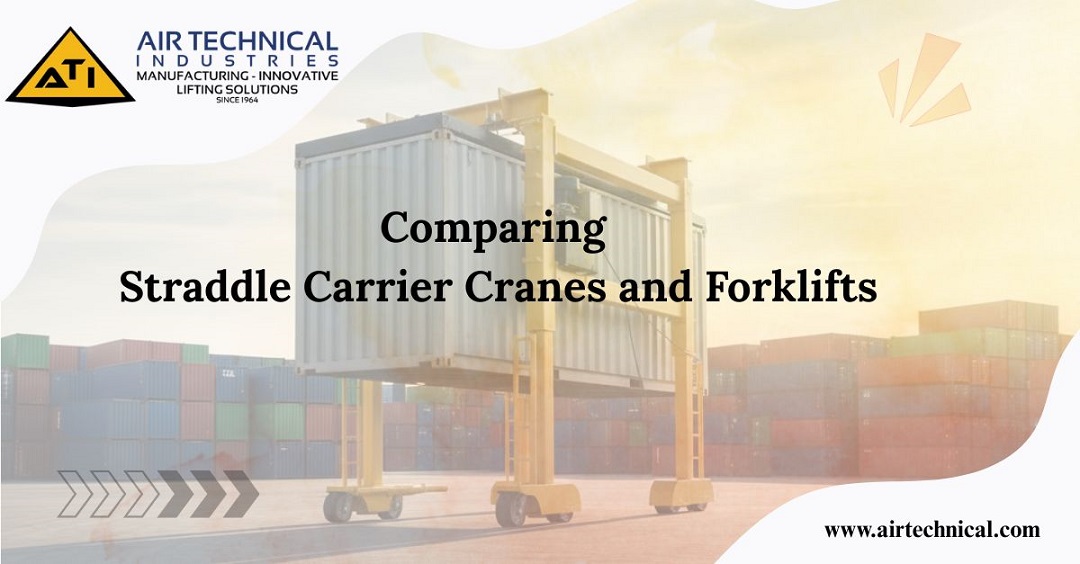
When your facility handles shipping containers regularly, choosing the right equipment can make or break your operational efficiency. If you’re currently wrestling with the limitations of traditional forklifts or considering an equipment upgrade, you’ve probably wondered: Should I invest in a straddle carrier crane or stick with forklifts?
The answer isn’t always straightforward, but after analyzing real-world applications across American ports, warehouses, and manufacturing facilities, we’ve uncovered some eye-opening insights that might surprise you.
The Real Problem with Traditional Forklifts for Container Handling
Picture this: It’s Monday morning at your facility. A fully loaded shipping container arrives on a truck. Your forklift operator approaches, only to realize the harsh reality that most industrial forklifts, including a straddle forklift, have significantly lower lifting capacity than what’s needed for heavy containers.
This scenario plays out thousands of times daily across American facilities, forcing operators into expensive workarounds:
- Multiple forklift coordination – requiring multiple units working simultaneously
- Partial unloading – removing contents before moving containers
- Crane rentals – adding significant daily equipment costs
- Extended handling times – operations that should be quick stretch significantly longer
But capacity isn’t the only limitation crushing operational efficiency.
The Hidden Costs of Forklift-Based Container Handling
Reach Limitations: Standard forklifts have limited extension reach, while shipping containers often need precise placement at distances that exceed forklift capabilities.
Ground Clearance Issues: Traditional forklifts work well when loading containers on and off trucks but struggle with versatility in varied terrain conditions common in outdoor yards.
Weather Dependency: Most forklifts aren’t designed for consistent outdoor operation, limiting productivity during harsh weather conditions.
Operator Safety Concerns: Handling oversized loads with undersized equipment increases accident risks and insurance liabilities.
Enter the Game-Changer: Straddle Carrier Crane Technology
Straddle carrier cranes eliminate the need for additional cranes or forklifts by simply straddling and lifting container units, while also being able to move with their loads a capability that transforms container handling operations. A modern container straddle crane provides both lifting power and mobility, making it a preferred solution for high-volume container handling environments.
What Makes Straddle Carrier Cranes Superior?
Massive Load Capacity: Modern straddle carrier cranes handle significantly heavier loads than traditional forklifts – often multiple times the capacity of heavy-duty forklifts.
Extended Reach: With superior vertical travel and telescopic capabilities, a straddle crane can position containers exactly where needed without repositioning equipment.
All-Weather Performance: Built for outdoor operation, these machines maintain productivity regardless of weather conditions – crucial for American facilities dealing with seasonal challenges.
Mobile Flexibility: Unlike fixed cranes, straddle carrier cranes move freely around your facility, handling containers anywhere within your operational area.
Head-to-Head Comparison: Straddle Carrier Crane vs Traditional Forklifts
| Factor | Traditional Forklifts | Straddle Carrier Cranes |
| Load Capacity | Limited for heavy containers | Superior capacity for heavy loads |
| Container Handling Time | Longer (often requires coordination) | Faster (single operator) |
| Equipment Required | Multiple units often needed | Single unit operation |
| Outdoor Capability | Limited/weather dependent | All-weather operation |
| Vertical Reach | Standard limitations | Extended reach capabilities |
| Ground Clearance | Standard (smooth surfaces) | High clearance (rough terrain) |
| Operator Training | Standard certification | Specialized but straightforward |
| Initial Investment | Lower upfront cost | Higher initial investment |
Real-World Cost Analysis: Why ROI Matters
While specific costs vary significantly based on your operation size, container volume, and regional factors, the fundamental economics often favor a straddle carrier crane for medium-to-high volume operations.
Key Cost Considerations:
Traditional Forklift Operations:
- Multiple equipment units often required
- Higher labor costs due to coordination needs
- Longer handling times per container
- Potential for equipment rental costs during peak periods
- Weather-related productivity losses
Straddle Carrier Crane Operations:
- Single operator efficiency
- Reduced handling time per container
- Consistent all-weather productivity
- Lower long-term maintenance complexity
- Improved operational flexibility
The ROI Timeline
Most facilities report that the operational savings from improved efficiency and reduced labor requirements justify the initial investment within 2-4 years, depending on container volume and current operational costs. In some cases, ROI can be achieved within one (1) year, which is unheard of for such capital equipment.
For accurate ROI calculations specific to your operation, consult with equipment specialists who can analyze your actual container volumes, current costs, and operational requirements.
When Forklifts Still Make Sense
Despite the advantages of straddle carrier cranes, forklifts remain the better choice for certain applications:
Low-Volume Operations: Facilities handling fewer containers monthly may find forklifts more cost-effective for their specific needs.
Multi-Purpose Facilities: If your operation requires versatile material handling beyond containers (pallets, machinery, varied cargo), forklifts offer greater flexibility.
Budget Constraints: Facilities with limited capital budgets may find the lower initial investment of forklifts more manageable.
Indoor-Only Operations: Climate-controlled facilities without outdoor handling requirements may not need the weather-resistant capabilities of a straddle lift crane.
The Straddle Carrier Crane Advantage: Beyond Basic Lifting
Modern straddle carrier cranes offer features that traditional forklifts simply can’t match.
Power Options for Every Operation
Electric Models: Zero emissions for indoor/environmental compliance
Diesel Engines: Maximum power for heavy-duty outdoor operations
Propane Systems: Balanced performance with lower emissions
Battery-Powered: Extended runtime with rapid charging capabilities
Mobility Solutions
Self-Propelled Models: Independent operation with powered steering
Towable Configurations: Flexible positioning with tow tugs or trucks
Two-Wheel/Four-Wheel Drive: Optimized traction for various surfaces
Advanced Safety Features
Load Monitoring Systems: Real-time weight distribution feedback
Stability Controls: Preventing tip-over during heavy lifts
Operator Visibility: 360-degree sight lines for safer operation
Emergency Systems: Immediate load lowering and equipment shutdown
Making the Decision: Your Container Handling Checklist
Volume Assessment:
- Do you handle containers regularly as part of your operations?
- Are container weights consistently challenging for your current equipment?
- Do you anticipate growth in container handling requirements?
Operational Requirements:
- Do you need outdoor, all-weather capability?
- Is precise container positioning critical to your workflow?
- Are you currently using multiple pieces of equipment for single tasks?
Financial Considerations:
- Can you justify the initial investment with operational savings?
- Are labor costs and equipment coordination affecting profitability?
- Do you have space and infrastructure for larger equipment such as a container straddle crane?
Future Planning:
- Are you planning facility expansion or increased capacity?
- Do environmental regulations affect your equipment choices?
- Is equipment versatility important for changing operational needs?
The Bottom Line: Choose Based on Your Reality
For facilities handling heavy containers regularly, straddle carrier cranes deliver superior ROI through reduced labor costs, faster handling times, and enhanced operational flexibility. Whether you choose a straddle crane, straddle lift crane, or a larger container straddle crane, the initial investment can pay for itself through increased efficiency and reduced operational complexity.
However, if your operation is small-scale, indoor-focused, or requires maximum equipment versatility, traditional forklifts remain a solid choice.
Take Action: Transform Your Container Handling Operations
Ready to eliminate the frustrations of undersized equipment and unlock your facility’s true productivity potential?
Consider the Air Technical Industries Tele-Mast Straddle Crane engineered specifically for demanding operations with:
- Superior lifting capacity for heavy containers
- Extended vertical reach capabilities
- Multiple power configurations
- Weather-resistant construction
- Self-propelled and towable models
Don’t let equipment limitations dictate your operational capacity. Contact Air Technical Industries today for a customized container handling assessment and discover how the right straddle carrier crane can transform your productivity.
Ready to make the switch? Request a detailed quote and ROI analysis tailored to your specific container handling requirements.
Frequently Asked Questions (FAQ’s)
1. What is the difference between a straddle carrier crane and a traditional forklift?
A straddle carrier crane lifts and transports compatible heavy or oversized loads within its supporting frame, while a traditional forklift uses forks to lift and move palletized materials and other suitable loads. The best option depends on load capacity, lifting height, handling frequency, and facility layout.
2. Can a straddle carrier crane handle heavy shipping containers?
Yes, a suitably rated straddle carrier crane can handle compatible shipping containers when equipped with the appropriate lifting attachment. Always verify the load weight, container dimensions, rated capacity, and lifting configuration before selecting equipment.
3. Is a straddle carrier crane better than a forklift for heavy container handling?
A straddle carrier crane may be more suitable for frequent heavy-load handling when a forklift cannot safely meet the required capacity or lifting height. Forklifts are often more economical for lighter loads, palletized goods, and multipurpose material handling. Compare operating requirements and total ownership costs before deciding.
4. How much does a straddle carrier crane cost compared with a forklift?
A straddle carrier crane generally requires a higher initial investment than a conventional forklift, depending on its capacity, lifting height, mobility, and customization. However, it may reduce labor requirements, handling time, and equipment rental costs in demanding applications. Compare purchase price, maintenance, operating costs, and expected savings to determine the best long-term value.
5. How do you choose the right equipment for heavy container handling?
Consider maximum load weight, container dimensions, lifting height, required travel distance, floor conditions, available operating space, handling frequency, and safety requirements. Also evaluate power options, maintenance needs, and compatibility with lifting attachments. Consult the manufacturer to confirm the equipment configuration meets your application requirements.

Vida Novak is the President of Air Technical Industries (ATI). With his over 25-year tenure at ATI Vida has earned progressive career advancements with increasing levels of responsibilities, including in engineering, technical sales, and operations management. Vida has gain keen insights into complex industrial material handling challenges. An endless number of manufacturers count on ATI’s ingenuity to solve complex and challenging material handling issues, whether for an international space station, a nuclear power plant, automotive plant, food factory, or a military base, among many others.